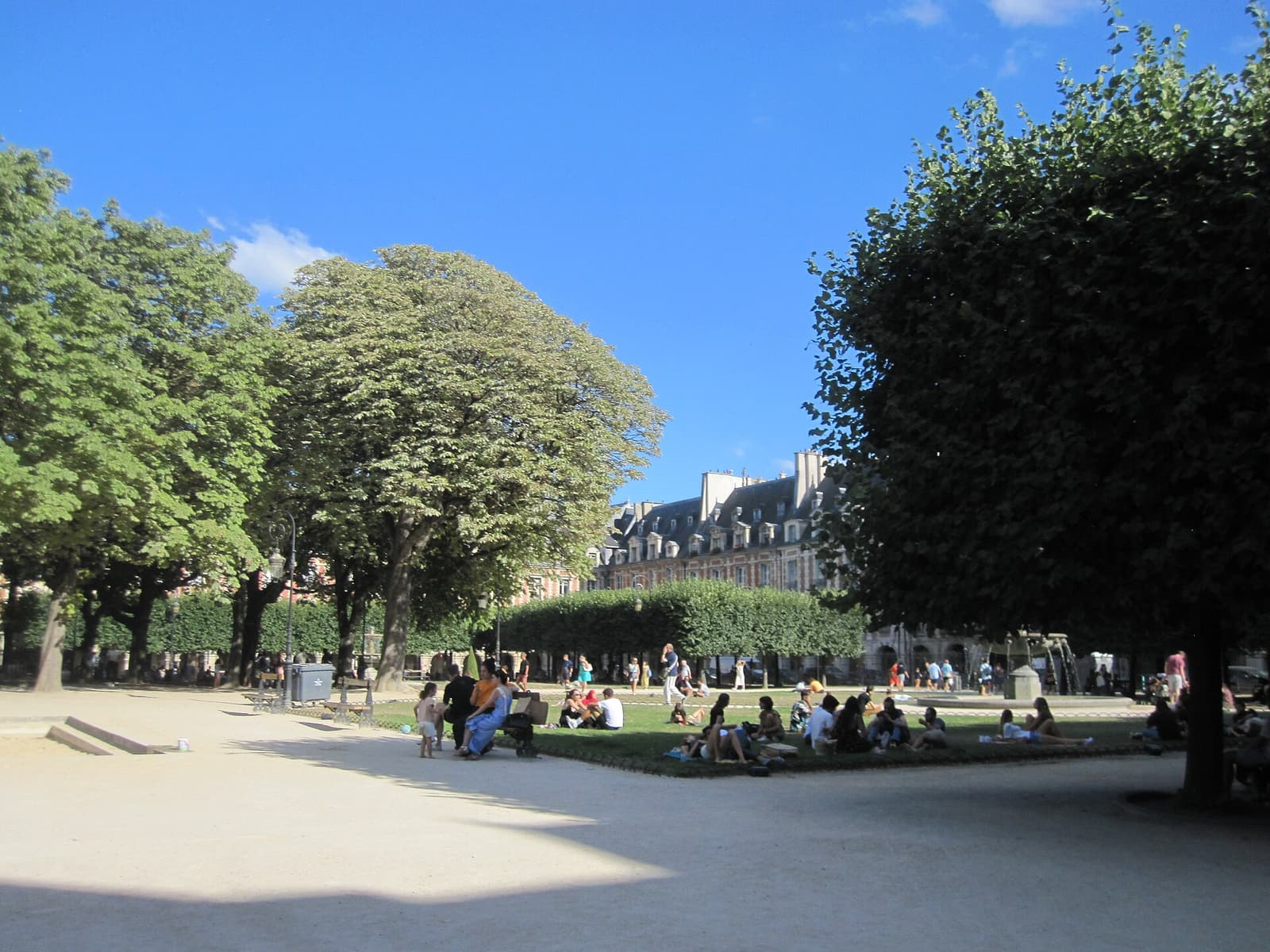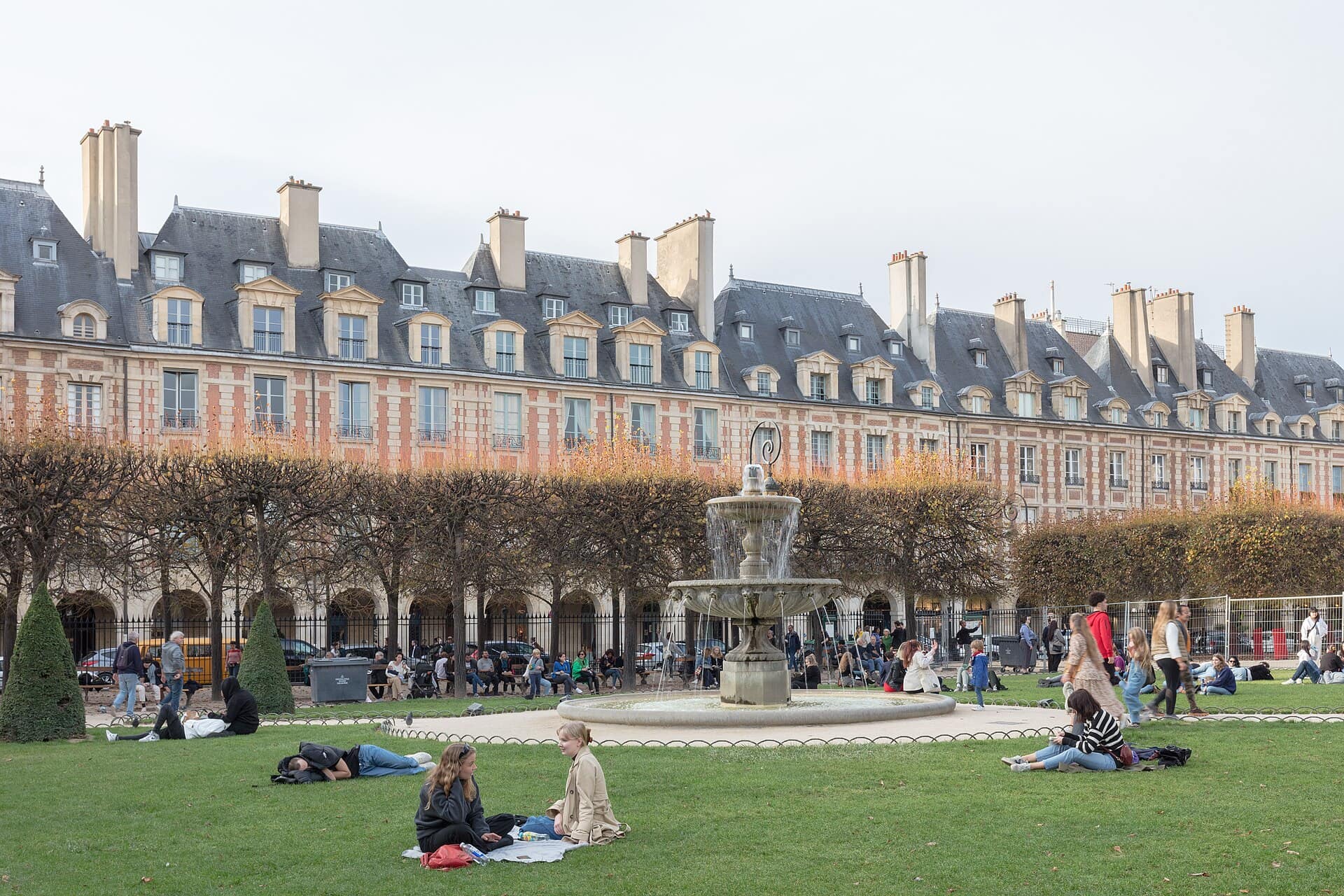
The Place des Vosges is a square of 36 red-brick and stone houses around a garden, completed in 1612 under the name Place Royale. It is the oldest planned square in Paris and the anchor of the Marais, the old aristocratic quarter that escaped Baron Haussmann’s 19th-century rebuilding and so kept its narrow streets and Renaissance and 17th-century mansions. This guide covers how to make the most of both.
A short history of the square
The site was once occupied by the Hôtel des Tournelles, a royal residence where King Henri II died in 1559 after a lance splintered into his eye during a tournament. His widow Catherine de’ Medici abandoned the palace, and it was later demolished. In 1605 Henri IV decided to build a square here with uniform houses — partly to house a silk manufactory, partly to give Paris a grand setting for public celebrations. He was assassinated in 1610, and the square was inaugurated in April 1612 with a vast three-day carousel — a courtly equestrian pageant — to celebrate the engagement of Louis XIII and Anne of Austria.
The Place Royale became the most fashionable address in Paris. Aristocrats built behind its facades, duels were fought in its garden (most famously in 1627, in defiance of Cardinal Richelieu’s ban), and salons flourished under its arcades. When the court moved to Versailles later in the century, the Marais slowly declined; by the 19th century its mansions had become workshops and tenements. The square was renamed Place des Vosges in 1800, after the first département to pay its taxes to the Republic.
The rescue came in the 1960s: the Loi Malraux of 1962 protected historic districts, and the Marais became one of the first “safeguarded sectors” in France. Decades of restoration turned it into the elegant, lively district you see today.
How long do you need?
- An hour — the square, the arcades and a coffee, with the Hôtel de Sully passage on the way in or out.
- Half a day — add the Maison de Victor Hugo and a walk down Rue des Francs-Bourgeois to Rue des Rosiers for falafel.
- A full day — add the Musée Carnavalet or the Musée Picasso, Village Saint-Paul and the Île Saint-Louis at sunset.
- Several days — stay in the Marais and use it as your base for all of Paris: it is central, walkable and well connected.
What to see
 The Place des Vosges
Place des Vosges
The royal square of 1612
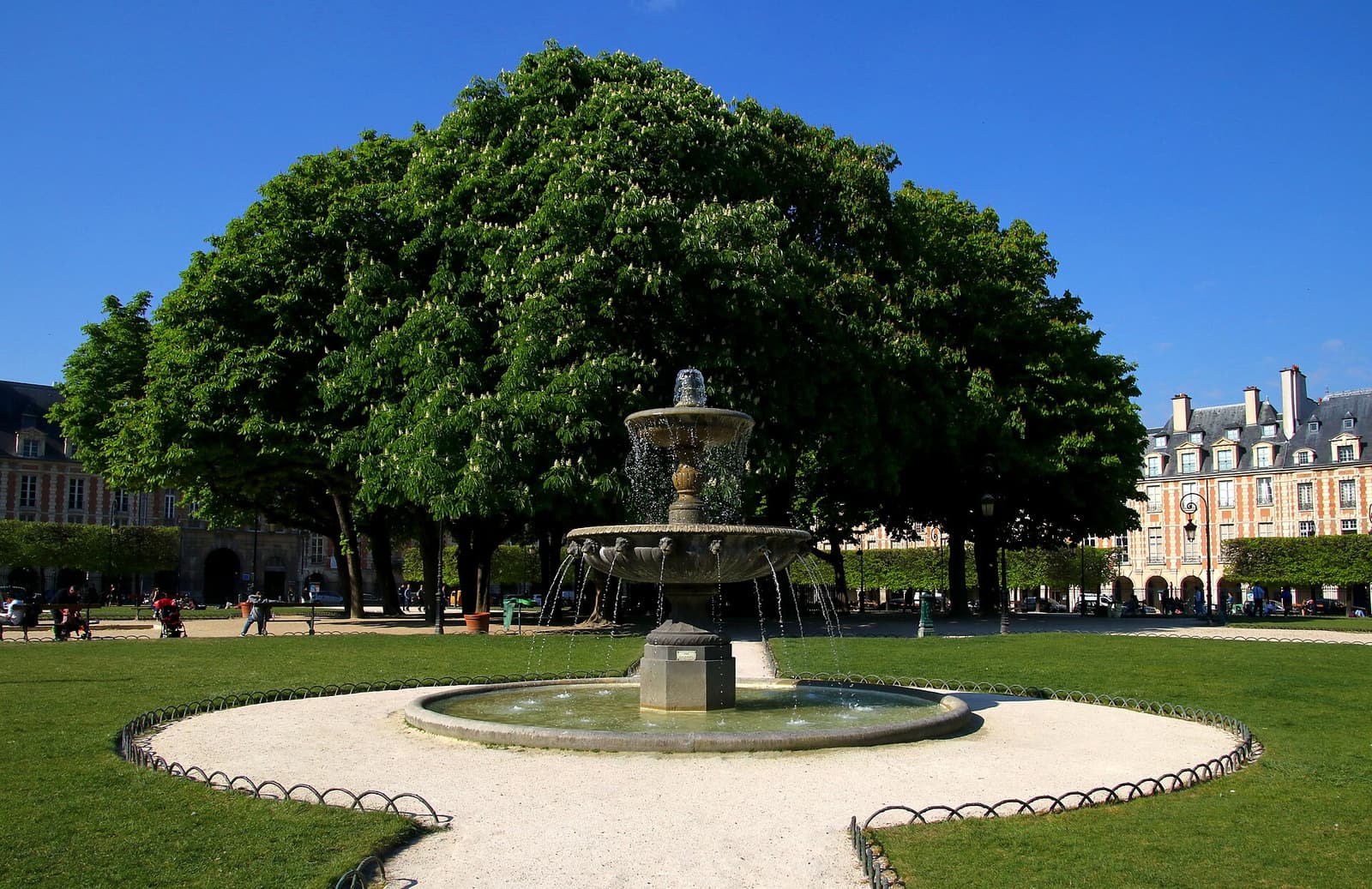
Paris’s oldest planned square: thirty-six red-brick and stone houses built to one design around a garden of lime trees and fountains, with vaulted arcades running all the way round. Laid out under Henri IV and inaugurated in 1612 as the Place Royale, it is still one of the most beautiful public spaces in Europe — and it is free.
 The Place des Vosges
Maison de Victor Hugo
The writer’s apartment, free to visit
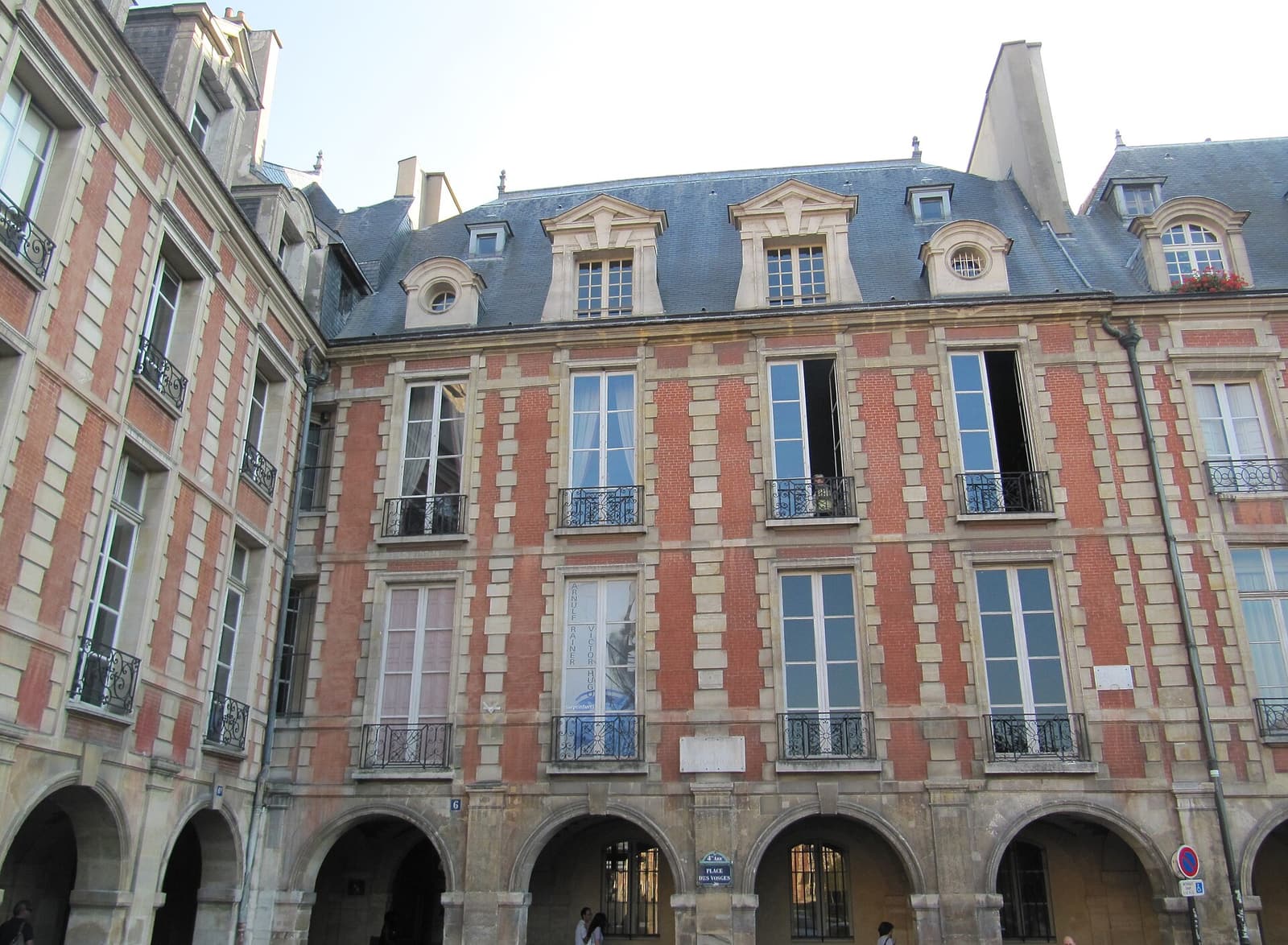
From 1832 to 1848 Victor Hugo rented a second-floor apartment at no. 6 on the square. Today it is a free municipal museum: rooms that follow his life before, during and after exile, including the extraordinary Chinese drawing room he designed himself — plus a courtyard garden café.
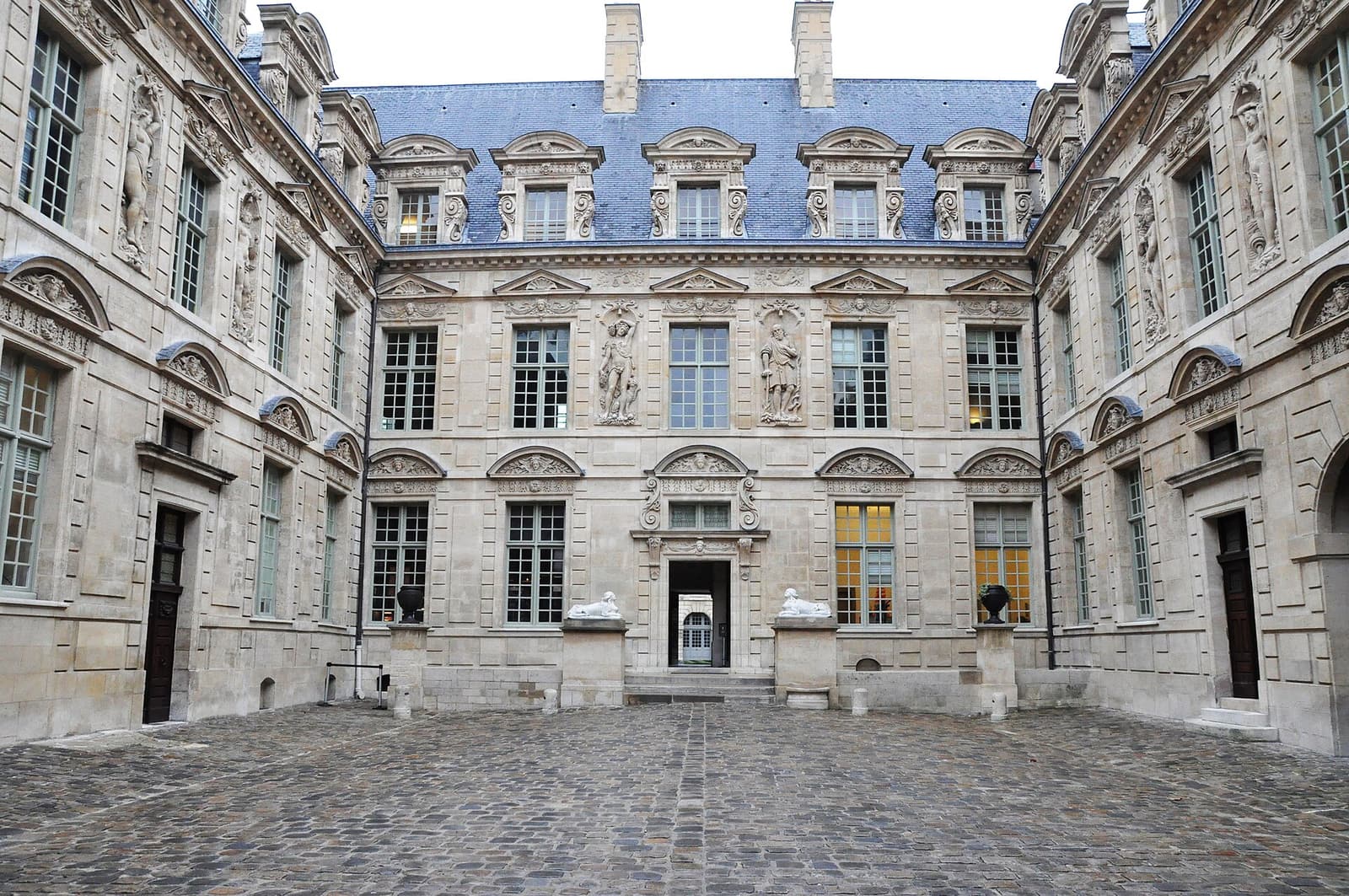 The Place des Vosges
Hôtel de Sully
A secret passage into the square
A superb early-17th-century mansion on Rue Saint-Antoine, bought by Henri IV’s former minister the Duke of Sully. Walk through its sculpted courtyard and formal garden and a small door in the orangery lets you out under the arcades of the Place des Vosges — the most elegant shortcut in Paris.
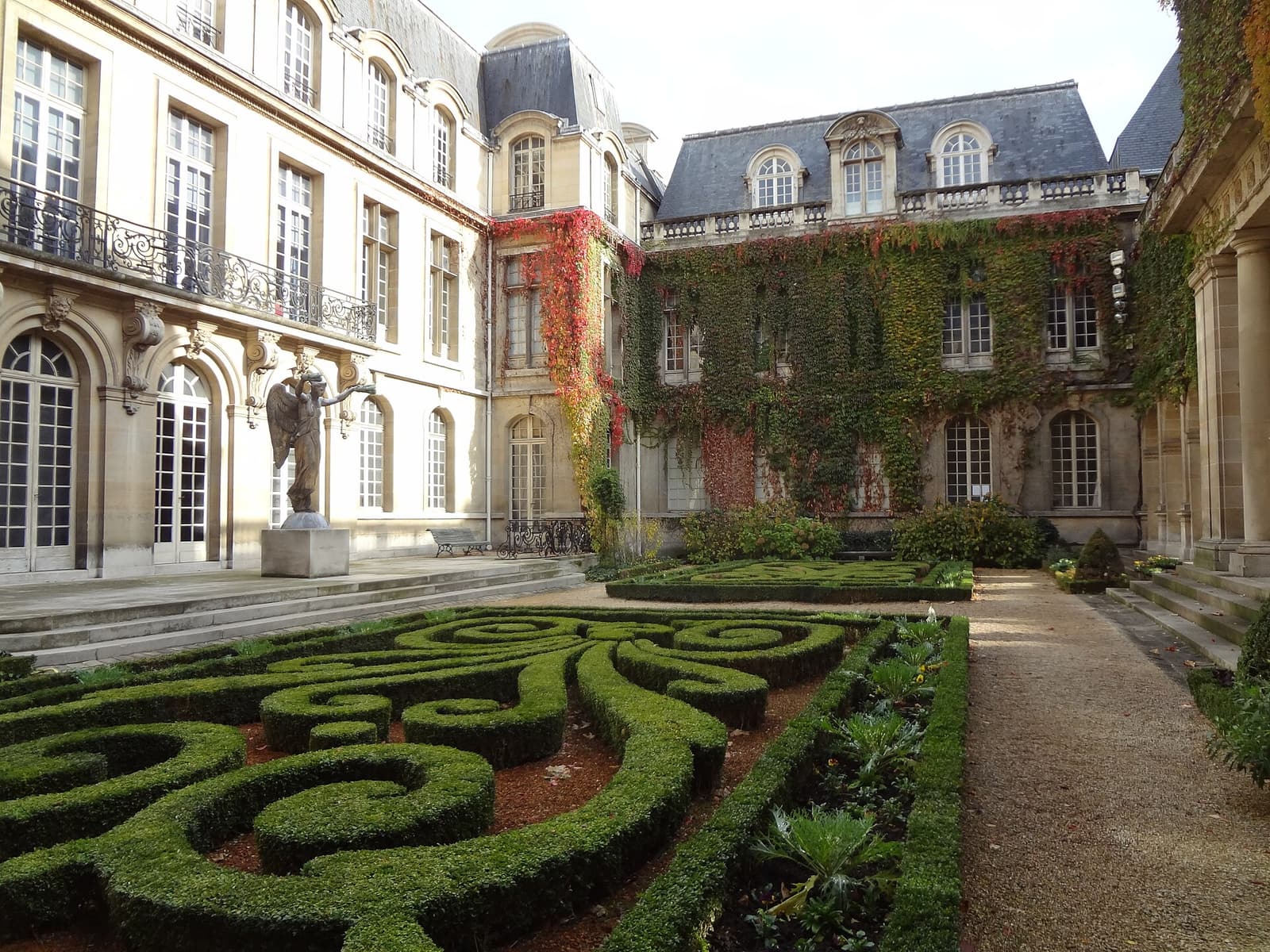 Around the Marais
Musée Carnavalet
The free museum of the history of Paris
Two 16th- and 17th-century mansions, one of them home to the letter-writer Madame de Sévigné, hold the story of Paris from prehistoric canoes to the Revolution, Belle Époque shop fronts and Proust’s bedroom. Thoroughly renovated and reopened in 2021, its permanent collection is free.
See all of them, with directions and tours, in our things to see guide.
Three walking itineraries
1. The royal Marais (2 hours)
Start at Métro Saint-Paul. Enter the Hôtel de Sully at 62 Rue Saint-Antoine and walk through its garden into the Place des Vosges. Circle the arcades, visit the Maison de Victor Hugo, then leave by the north-west corner along Rue des Francs-Bourgeois to the Musée Carnavalet and the courtyard of the Hôtel de Soubise.
2. Jewish Marais and hidden courtyards (2–3 hours)
From the Place des Vosges, walk to Rue Pavée to see Guimard’s synagogue, then along Rue des Rosiers for falafel and Yiddish pastries. Find the hidden Jardin des Rosiers, cross to the Place du Marché Sainte-Catherine, and finish at the Mémorial de la Shoah on Rue Geoffroy-l’Asnier.
3. From the square to the islands (2–3 hours)
Leave the square through the Hôtel de Sully, cross Rue Saint-Antoine to the church of Saint-Paul-Saint-Louis, browse the courtyards of Village Saint-Paul, see the medieval wall and the Hôtel de Sens, then cross the Pont Marie to the Île Saint-Louis and continue to Notre-Dame.
What it costs
The Marais is one of the more expensive parts of Paris, but many of its highlights are free. Indicative prices at the time of writing:
| Item | Typical price |
|---|---|
| Place des Vosges, garden, arcades | Free |
| Maison de Victor Hugo, Musée Carnavalet (permanent collections) | Free |
| Musée Picasso, adult ticket | ≈ €14–16 |
| Métro/RER single ticket (Paris region) | ≈ €2.50 |
| Espresso at the counter / on a terrace | ≈ €1.50–2.50 / €3–4 |
| Falafel pitta to take away | ≈ €8–12 |
| Bistro lunch menu | ≈ €18–30 |
| Glass of wine in a bar | ≈ €6–10 |
| Hotel double, per night | From ≈ €150 in simple hotels to €600+ at the top end |
| Paris tourist tax (hotel guests) | A few euros per person per night, by category |
Where to eat and drink
The Marais is one of the great eating districts of Paris. Under the arcades of the square you will find classic cafés and brasseries, the pastry shop Carette, and at no. 9 L’Ambroisie, one of the most celebrated three-Michelin-star restaurants in France. On and around Rue des Rosiers: falafel, Yiddish bakeries and Israeli street food. In the Haut-Marais, the Marché des Enfants Rouges is a lunchtime institution. The district is also famous for its tea house Mariage Frères, Breton crêpes, chocolatiers and natural-wine bars. For a picnic in the square, buy bread, cheese and pastries on Rue Saint-Antoine.
Restaurants change often; ask your hotel for current favourites, or let a food tour do the choosing.
Shopping
The Marais is one of the few parts of Paris where most shops open on Sundays, which makes it busy at weekends. Rue des Francs-Bourgeois and Rue Vieille-du-Temple are lined with French fashion labels and concept stores; the Haut-Marais (Rue Charlot, Rue de Bretagne) has independent designers; the arcades of the square specialise in art galleries; Village Saint-Paul in antiques.
Where to stay
The Marais is one of the best bases in Paris. Options fall into two groups:
- Around the square, Saint-Paul and the Bastille — from the Pavillon de la Reine on the Place des Vosges itself to good-value three-stars.
- Elsewhere in the Marais and on the Île Saint-Louis — boutique and design hotels in the Haut-Marais and near the Hôtel de Ville, and quiet island hotels.
We compare the best of each, with live rates, on our where to stay page.
Practical details
- Money: euro. Cards (including contactless) are accepted almost everywhere; carry a little cash for markets and small bakeries.
- Tipping: service is included in French restaurant bills. Rounding up or leaving a few euros for good service is appreciated but not expected.
- Opening days: many museums close on Mondays (Carnavalet, Victor Hugo, Picasso) — plan accordingly. Jewish-owned shops on Rue des Rosiers close on Saturdays.
- Safety: the Marais is safe day and night. As everywhere in central Paris, watch for pickpockets on Métro line 1, at the Bastille and in crowds, and keep phones off café tables.
- Toilets: free automatic public toilets are found on many streets; museums and cafés are the other option.
- Water: Paris tap water is safe, and you can refill bottles at the green Wallace fountains.
- Language: a “Bonjour” when entering a shop or café goes a long way.
Mistakes to avoid
- Visiting the museums on a Monday — most are closed.
- Planning a Rue des Rosiers falafel on a Saturday — many places are closed for Shabbat.
- Missing the Hôtel de Sully passage — it’s the best way in.
- Walking straight past the courtyards: push open the gates of the mansions when they are open to visitors; many hide gardens.
- Booking the Eiffel Tower, the Louvre or the Catacombs at the last minute — timed tickets sell out.